Last Click Attribution: Why It’s Misleading and What to Use Instead
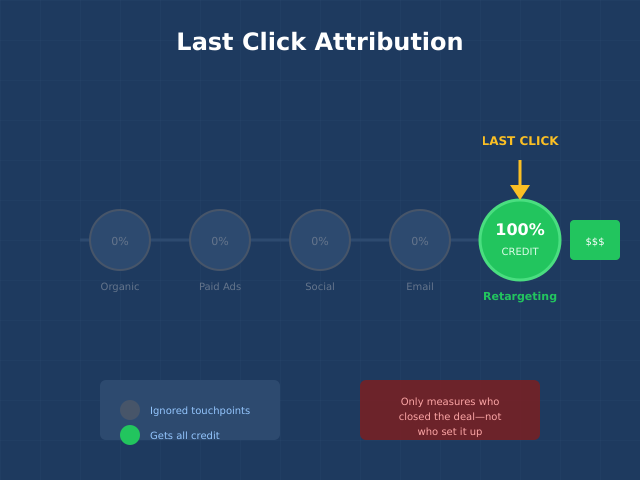
Last click attribution gives 100% credit to the final touchpoint before conversion. It’s the default model in most analytics platforms—and one of the most misleading ways to measure marketing performance.
This guide explains how last click attribution works, when it makes sense, and why relying on it exclusively leads to poor budget decisions. You’ll also learn how to combine it with other models for a more accurate picture.
What Is Last Click Attribution?
Last click attribution is a single-touch attribution model that assigns all conversion credit to the last marketing channel a customer interacted with before converting. Every other touchpoint in the journey receives zero credit.
| Component | How Last Click Handles It |
|---|---|
| First touchpoint | 0% credit |
| Middle touchpoints | 0% credit |
| Last touchpoint | 100% credit |
| Time consideration | None—only position matters |
| Channel weighting | None—all channels treated equally |
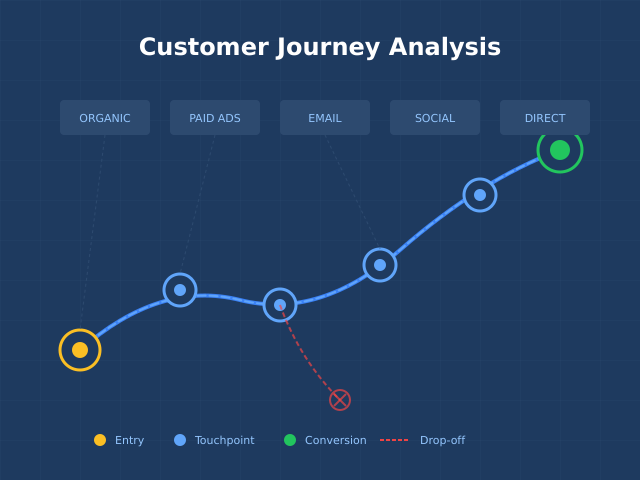
The model assumes the final interaction was the deciding factor. A customer might have discovered your brand through a blog post, compared options via review sites, and clicked a retargeting ad before purchasing—but only the retargeting ad gets credit.
How Last Click Attribution Works: Example
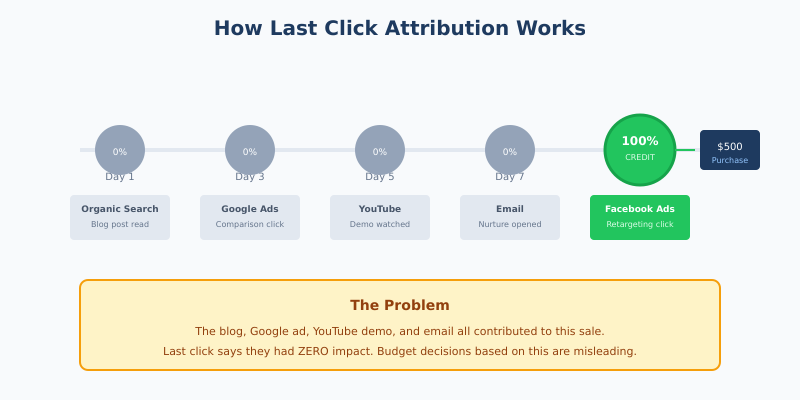
Consider a customer’s path to purchasing project management software:
| Day | Touchpoint | Channel | Credit (Last Click) |
|---|---|---|---|
| Day 1 | Reads blog post “Best PM Tools 2026” | Organic Search | 0% |
| Day 3 | Clicks comparison ad | Google Ads | 0% |
| Day 5 | Watches product demo on YouTube | YouTube | 0% |
| Day 7 | Opens nurture email | 0% | |
| Day 10 | Clicks retargeting ad, purchases | Facebook Ads | 100% |
Under last click attribution, Facebook Ads receives full credit for the $500 conversion. The blog post that introduced the brand, the Google ad that drove consideration, and the email that kept the prospect engaged—all register as having zero impact.
This creates a distorted view of channel performance. If you optimized spending based purely on this data, you’d increase Facebook retargeting budget while cutting the organic content and Google Ads that actually filled the funnel.
Why Last Click Is the Default (And Why That’s a Problem)
Last click became the default attribution model for practical reasons:
- Technical simplicity: Requires only basic tracking—no cross-device identification or complex data processing
- Clear accountability: One channel, one number, easy reporting
- Historical precedent: Established before multi-touch tracking was technically feasible
But customer journeys have changed. Research from Gartner shows B2B buyers now interact with 8-15 touchpoints before purchasing. For B2C, even “impulse” purchases often involve 3-5 touchpoints across multiple days.
Using last click in this environment is like judging a relay race by only timing the final runner. You’ll know who crossed the finish line, but nothing about how you got there.
When Last Click Attribution Makes Sense
Despite its limitations, last click attribution works well in specific scenarios:
| Scenario | Why Last Click Works | Example |
|---|---|---|
| Single-session conversions | One touchpoint = accurate credit | Impulse e-commerce purchases |
| Bottom-funnel campaigns | Measures closing effectiveness | Retargeting, abandoned cart emails |
| Direct response ads | Intent is already established | Brand search campaigns |
| Short sales cycles | Fewer touchpoints to miss | Low-cost consumer products |
| Baseline comparison | Universal standard across tools | Comparing platforms’ reported conversions |
If your average customer journey has 1-2 touchpoints and happens within a single session, last click attribution may be accurate enough. The problems arise when journeys are longer and more complex.
The Real Cost of Last Click: What You Miss
Relying exclusively on last click attribution creates systematic blind spots:
1. Awareness Channels Look Worthless
Content marketing, display ads, social media posts, and PR never get credit because they rarely drive immediate conversions. A blog post might introduce 10,000 people to your brand, with 500 eventually converting—but last click shows zero conversions from organic content.
The result: Marketing teams cut awareness spending, pipeline shrinks 6-12 months later, and nobody connects the cause.
2. Retargeting Gets Overcredited
Retargeting ads frequently capture the last click because they target people already considering purchase. They’re effective, but they can’t exist without upstream channels filling the audience pool.
The result: Retargeting budgets grow while prospecting budgets shrink. Eventually, the retargeting pool dries up because nobody new is entering the funnel.
3. Email Appears Overperforming
Email often captures conversions from subscribers who were already convinced. The email didn’t persuade them—it just happened to be the last thing they clicked.
The result: Teams send more emails to squeeze conversions, damaging deliverability and subscriber relationships.
4. Assisted Conversions Disappear
A channel might assist 500 conversions (appearing somewhere in the journey) while only getting last-click credit for 50. Under last click, that channel shows 10% of its true impact.
The result: High-assist, low-last-click channels get cut despite driving significant revenue.
Last Click vs. Other Attribution Models
Understanding alternatives helps you see what last click misses:
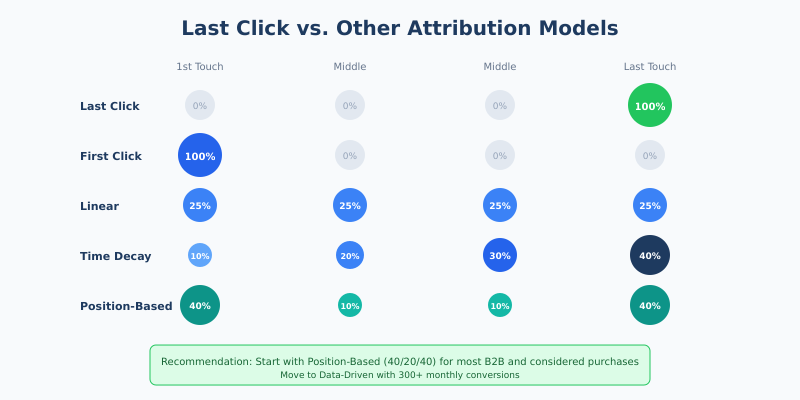
| Model | Credit Distribution | Best For | Limitation |
|---|---|---|---|
| Last Click | 100% to final touchpoint | Short journeys, bottom-funnel analysis | Ignores awareness/consideration |
| First Click | 100% to first touchpoint | Understanding discovery channels | Ignores conversion drivers |
| Linear | Equal split across all | Balanced view of all channels | Assumes equal influence |
| Time Decay | More credit to recent touches | Longer sales cycles | Still undervalues early touches |
| Position-Based | 40% first, 40% last, 20% middle | Most B2B journeys | Arbitrary weight distribution |
| Data-Driven | ML-based on actual patterns | High-volume, complex journeys | Requires significant data |
No single model is “correct”—each reveals different aspects of channel performance. The channels that show dramatically different results across models are the ones most affected by your model choice.
How to Move Beyond Last Click
Step 1: Run Model Comparison Reports
Most analytics platforms let you view the same data through multiple attribution lenses. Compare last click against linear and position-based models. Look for channels with big discrepancies:
- High in position-based, low in last click: Strong awareness channel being undervalued
- High in last click, low in first click: Closing channel, not discovery channel
- Similar across all models: Consistent performer throughout the funnel
Step 2: Check Assisted Conversions
Review assisted conversion reports to see which channels appear in journeys without getting last-click credit. A channel with high assists and low last-clicks is doing valuable work that last click doesn’t capture.
Assist Ratio = Assisted Conversions ÷ Last Click Conversions
| Assist Ratio | Interpretation |
|---|---|
| < 1 | Channel is primarily a closer |
| = 1 | Balanced assist and close role |
| > 1 | Channel is primarily an assister |
| > 5 | Strong awareness channel, rarely closes |
Step 3: Analyze Path Length
Check how many touchpoints your average conversion involves. If it’s more than 2-3, last click is missing most of the picture.
| Avg. Path Length | Last Click Accuracy | Recommended Approach |
|---|---|---|
| 1-2 touchpoints | High | Last click may be sufficient |
| 3-5 touchpoints | Medium | Use position-based or linear |
| 6+ touchpoints | Low | Use data-driven or custom model |
Step 4: Implement Multi-Touch Attribution
For most businesses, position-based attribution (40/20/40) provides a reasonable starting point. It credits both discovery and conversion while acknowledging middle touches.
Once you have 300+ conversions per month with 3+ touchpoints each, consider moving to data-driven attribution, which learns from your actual conversion patterns.
Common Mistakes with Last Click Attribution
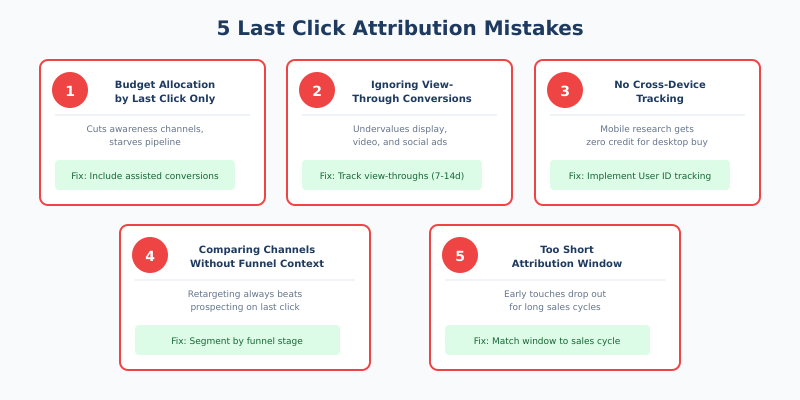
Mistake 1: Using Last Click for Budget Allocation
The most damaging mistake is shifting budget based purely on last-click data. Cutting channels that don’t show last-click conversions often removes the awareness efforts that feed your entire funnel.
Why it hurts: Pipeline shrinks over time as fewer people enter the journey. By the time you notice, it’s 3-6 months to rebuild.
Fix: Use multi-touch attribution or at minimum include assisted conversions in budget decisions. Never cut a channel without checking its assist ratio first.
Mistake 2: Ignoring View-Through Conversions
Last click only counts clicks, not impressions. A customer might see your display ad 10 times, then search for your brand directly. Last click credits brand search; the display ads that drove awareness get nothing.
Why it hurts: You undervalue display, video, and social ads that influence without immediate clicks.
Fix: Track view-through conversions with appropriate windows (7-14 days for display, 1-3 days for social). Weight them lower than click-throughs but don’t ignore them.
Mistake 3: Not Accounting for Cross-Device Journeys
A customer researches on mobile, then converts on desktop. Without cross-device tracking, last click sees two people: one mobile visitor who bounced, one desktop converter. Mobile gets no credit despite driving the research.
Why it hurts: Mobile channels look ineffective when they’re actually crucial for research.
Fix: Implement user ID tracking for logged-in users. For anonymous users, use probabilistic matching or at minimum analyze device categories separately.
Mistake 4: Comparing Channels Without Context
Comparing last-click conversions across channels ignores their different roles. Retargeting will always outperform prospecting on last click—that doesn’t mean prospecting is less valuable.
Why it hurts: You optimize for closers at the expense of openers, eventually running out of people to close.
Fix: Segment channels by funnel stage. Compare awareness channels to each other, consideration channels to each other, and closing channels to each other.
Mistake 5: Setting Conversion Windows Too Short
Default attribution windows are often 30 days. For B2B or high-consideration purchases, journeys routinely exceed this. Touchpoints outside the window get no credit at all.
Why it hurts: Early-journey touches drop out of attribution entirely, making your data even less complete.
Fix: Set attribution windows based on your actual sales cycle. If average time to conversion is 45 days, use a 60-90 day window.
Last Click in Google Analytics 4
GA4 uses data-driven attribution as its default, a significant shift from Universal Analytics’ last-click default. However, you can still access last-click data:
- Advertising snapshot: Shows data-driven attribution by default
- Model comparison: Compare data-driven against last click, first click, linear, position-based, and time decay
- Conversion paths: See full journeys regardless of attribution model
If you’re migrating from Universal Analytics, expect your channel performance numbers to shift. Channels that primarily assist (organic search, content) will likely show higher credit under data-driven attribution than they did under last click.
Metrics Dashboard: Beyond Last Click
Build a dashboard that shows channel performance across multiple dimensions:
| Metric | What It Shows | Why It Matters |
|---|---|---|
| Last Click Conversions | Closing performance | Direct conversion impact |
| Assisted Conversions | Supporting role | Full journey contribution |
| Assist Ratio | Closer vs. opener | Channel role in funnel |
| First Click Conversions | Discovery performance | Top-of-funnel strength |
| Avg. Path Position | Where channel typically appears | Funnel stage alignment |
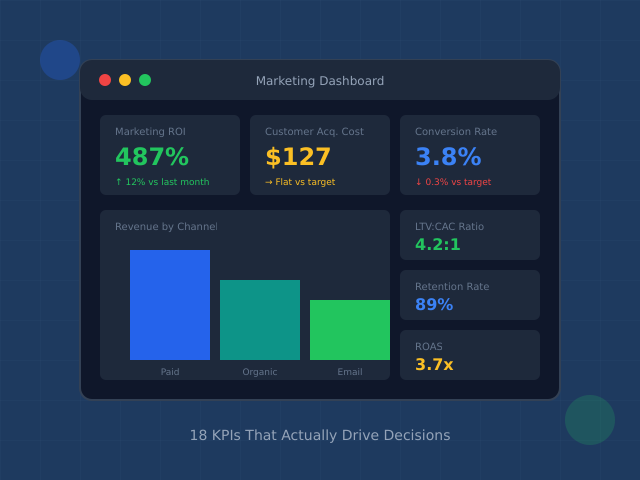
For deeper analysis of what metrics to track, see our marketing KPIs guide.
Continue Learning
Understand attribution in context with these related guides:
- Customer Journey Analysis — map the complete path to conversion
- Conversion Funnel Analysis — find where drop-offs happen
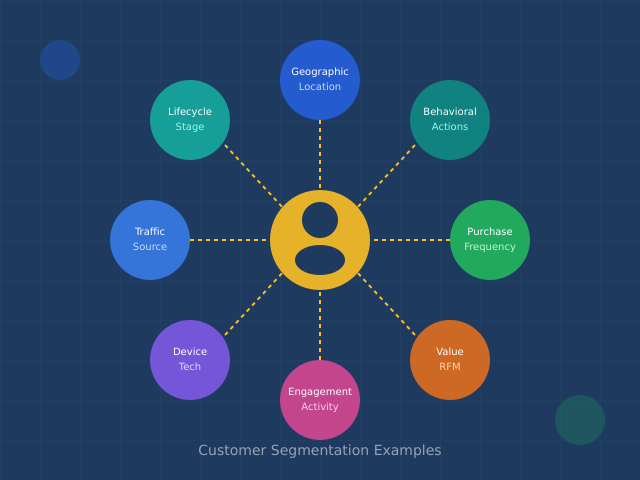
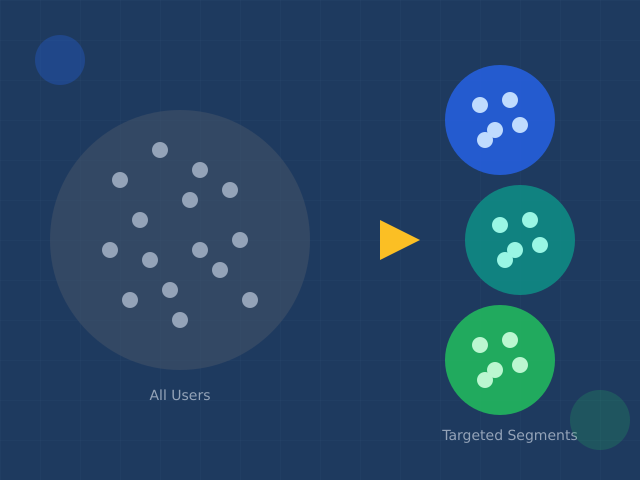
- Audience Segmentation Guide — analyze journeys by customer type
- Plausible Analytics Review — privacy-focused analytics options
Bottom Line
Last click attribution is simple, universal, and wrong for most modern marketing measurement. It credits closers while ignoring openers, rewards retargeting while starving prospecting, and creates a distorted picture of channel value.
Use last click as one data point among many, not as your primary decision-making tool. Compare it against other models, track assisted conversions, and understand that the last touch is rarely the only touch that mattered.
The goal isn’t to abandon last click entirely—it’s to recognize what it shows (who closed the deal) and what it hides (who set up the close).