First-Party Data Strategy: How to Collect and Use Your Own Data
Third-party cookies are disappearing. Google delayed it multiple times, but the direction is irreversible. Safari and Firefox already block them by default. The businesses that thrive in this new landscape share one trait: they built a first-party data strategy before they were forced to.
First-party data is information you collect directly from your customers and website visitors — with their knowledge and consent. It includes purchase history, form submissions, on-site behavior, email interactions, and survey responses. Unlike third-party data purchased from brokers, this data is accurate, privacy-compliant, and uniquely yours.
McKinsey research shows companies that activate first-party data in marketing functions achieve 2.9x higher customer retention and 1.5x greater ROI compared to those relying on third-party data. Those numbers are not marginal. They represent the gap between companies building direct relationships and those renting access to someone else’s audience.

First-Party vs. Second-Party vs. Third-Party Data
Before building a strategy, you need to understand what you are working with. These three categories differ in how data is collected, who owns it, and how reliably you can act on it.
| Data Type | Source | Ownership | Accuracy | Privacy Risk | Cost |
|---|---|---|---|---|---|
| First-party | Collected directly from your audience | You own it | High | Low (consent-based) | Collection infrastructure |
| Second-party | Another company’s first-party data, shared via partnership | Shared | Medium-High | Medium | Partnership or purchase |
| Third-party | Aggregated from many sources by data brokers | Licensed | Low-Medium | High | Subscription fees |
First-party data wins on every dimension that matters: accuracy, privacy compliance, and long-term value. The catch is that it requires effort to collect and infrastructure to activate. That effort, however, creates a competitive moat that purchased data never will.
Third-party data served marketers well for two decades. But regulatory pressure from GDPR and privacy regulations combined with browser-level tracking prevention has made it unreliable. Audience segments built on third-party cookies now miss 30-50% of users on Safari and Firefox.
Why First-Party Data Matters More Than Ever
The shift to first-party data is driven by three forces converging simultaneously. Understanding each one helps you build a strategy that addresses root causes rather than symptoms.
1. Cookie Deprecation Is Real
Chrome’s Privacy Sandbox may have delayed full cookie removal, but the ecosystem has already moved. Apple’s Intelligent Tracking Prevention blocks cross-site tracking by default. Firefox Enhanced Tracking Protection does the same. Over 40% of web traffic now occurs in environments where third-party cookies are blocked or restricted. If your analytics and marketing rely on cookie-based tracking, you are already flying partially blind.
2. Privacy Regulations Keep Expanding
GDPR was the starting gun. CCPA, Brazil’s LGPD, and a growing list of state-level US privacy laws followed. The pattern is consistent: more consent requirements, more restrictions on data sharing, higher penalties for violations. First-party data collected with clear consent is the safest foundation for any analytics or marketing program.
3. Data Quality Drives Performance
Third-party audience segments have always been noisy. A “high-intent auto buyer” segment from a data broker might contain users who read one car review six months ago. Your own purchase history, email engagement data, and on-site behavior signals are dramatically more accurate. Segmentation built on first-party data consistently outperforms purchased segments.

First-Party Data Collection Methods
Collecting first-party data does not require invasive surveillance. The best collection methods provide value to the user while generating insights for your business. Here are the primary channels, ranked by data richness.
Account Creation and Login Data
User accounts are the gold standard. When someone creates an account, you get a persistent identifier that works across devices and sessions — no cookies required. The key is offering genuine value in exchange: order tracking, saved preferences, personalized recommendations, or loyalty rewards.
Account-based data allows you to build a single customer view that connects website behavior, purchase history, email interactions, and support tickets. This unified profile is what makes personalization and accurate multi-touch attribution possible.
Forms and Lead Capture
Every form submission is a voluntary data exchange. Newsletter signups, gated content downloads, webinar registrations, and quote requests all generate first-party data. The critical factor is progressive profiling — don’t ask for 15 fields on the first interaction. Start with email, then gradually enrich the profile over subsequent touchpoints.
- Newsletter signup: Email + topic preferences
- Content download: Email + company size + role
- Free trial: Full contact details + use case
- Quote request: Detailed requirements + budget range
Purchase and Transaction History
Transaction data is the most valuable first-party data you have. It tells you what customers actually buy (not just what they browse), how often they purchase, their average order value, and their product preferences. For subscription businesses, it reveals churn risk signals and upsell opportunities.
On-Site Behavioral Data
Page views, scroll depth, time on page, search queries, product comparisons, and cart additions — all first-party behavioral data collected through your own analytics implementation. When combined with server-side tracking, this data remains accurate even when client-side cookies are blocked.
Surveys and Feedback
Surveys capture data that behavioral tracking cannot: preferences, satisfaction levels, purchase intent, and competitive context. Post-purchase surveys, NPS programs, and exit-intent polls all generate high-value first-party data. Keep them short — 3-5 questions maximum for the best completion rates.
Customer Service Interactions
Support tickets, live chat transcripts, and phone call notes contain valuable signals about product issues, feature requests, and customer satisfaction. Most companies ignore this data source. Those that integrate it into their customer data platform gain a significant advantage in understanding customer needs.
Customer Data Platforms: The Activation Layer
Collecting first-party data is only half the challenge. You need infrastructure to unify, segment, and activate it. That is where Customer Data Platforms (CDPs) come in.
A CDP ingests data from multiple sources, resolves customer identities across channels, builds unified profiles, and makes those profiles available to marketing and analytics tools. Without a CDP (or equivalent infrastructure), your first-party data stays siloed in email platforms, analytics tools, CRMs, and e-commerce databases.
| Platform | Best For | Starting Price | Key Strength |
|---|---|---|---|
| Segment | Mid-market to enterprise | $120/mo | Integration ecosystem (400+ connections) |
| Rudderstack | Developer-led teams | Free tier available | Open-source, warehouse-native |
| mParticle | Mobile-first companies | Custom pricing | Real-time audience sync |
| Treasure Data | Enterprise | Custom pricing | ML-powered identity resolution |
| Freshpaint | Healthcare | Custom pricing | HIPAA-compliant data routing |
For small to mid-sized businesses, Segment’s free tier or Rudderstack’s open-source version provides enough capability to start. The key is implementing a CDP before your data sources multiply — retrofitting identity resolution across disconnected systems is significantly harder than building it from the start.
Activation Strategies: Turning Data Into Revenue
First-party data sitting in a database generates zero value. These activation strategies connect your data to revenue-generating activities.
Personalization at Scale
Use behavioral and purchase data to personalize website content, email campaigns, and product recommendations. McKinsey reports that personalization can reduce customer acquisition costs by up to 50% and increase revenue by 5-15%. The highest-performing implementations personalize based on purchase history and browsing behavior, not just demographic data.
- Product recommendations based on purchase and browsing history
- Dynamic landing pages that adapt to visitor segment — see psychology of high-converting landing pages
- Email content blocks that change based on engagement history
- Search result ranking influenced by past behavior
Lookalike Audience Building
Upload your highest-value customer segments to advertising platforms (Meta, Google, LinkedIn) to build lookalike audiences. First-party seed audiences consistently outperform third-party segments because the source data is more accurate. A lookalike based on your top 1,000 customers by lifetime value will outperform one based on a purchased “in-market” audience every time.
Email Segmentation and Lifecycle Campaigns
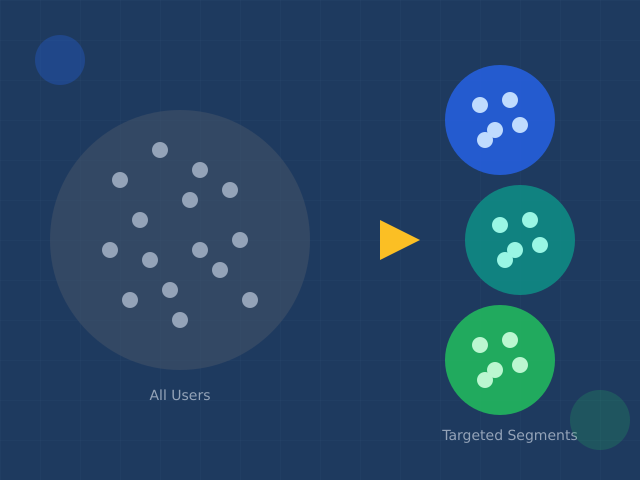
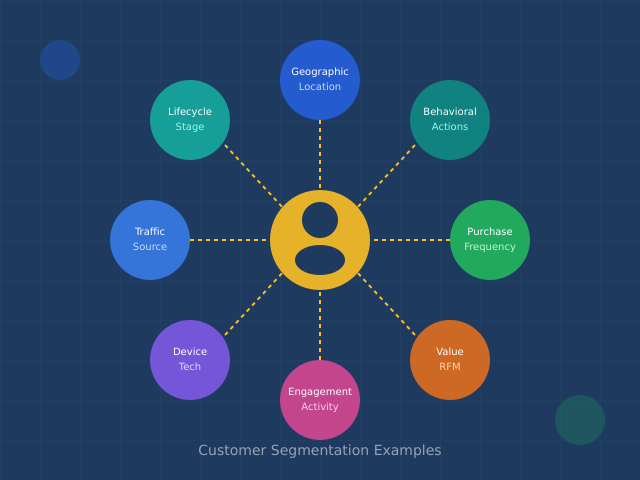
First-party data enables email segmentation that goes far beyond basic demographics. Segment by purchase frequency, average order value, product category affinity, content engagement level, and lifecycle stage. Behavioral triggers — abandoned cart, browse abandonment, replenishment reminders — drive significantly higher conversion rates than batch-and-blast campaigns.
Effective audience segmentation requires clean, unified data. If your email platform, analytics tool, and CRM contain conflicting information about the same customer, your segments will be unreliable.
Predictive Analytics and Churn Prevention
With enough first-party behavioral data, you can build models that predict which customers are likely to churn, which leads are most likely to convert, and which product a customer will buy next. These models improve over time as your dataset grows — another advantage of owned data over rented data.
ROI of First-Party Data Strategies
Quantifying the return on a first-party data strategy requires measuring both direct revenue impact and cost avoidance. Here are the benchmarks from published research.
| Metric | First-Party Data Impact | Source |
|---|---|---|
| Customer retention | 2.9x improvement | McKinsey, 2023 |
| Marketing ROI | 1.5x increase | McKinsey, 2023 |
| Acquisition cost reduction | Up to 50% | McKinsey, 2023 |
| Revenue per customer | 5-15% increase | McKinsey, 2023 |
| Ad targeting accuracy | 2-3x improvement vs. third-party | BCG, 2022 |
| Revenue from personalization | 40% more revenue | McKinsey, 2023 |
The cost side matters too. Third-party data subscriptions typically cost $10,000-$100,000+ per year. Regulatory fines for mishandling purchased data can be devastating. First-party data infrastructure requires upfront investment but generates compounding returns as your dataset grows. Make sure you are tracking the right KPIs to measure these returns.
Building Your Data Collection Infrastructure
A practical first-party data strategy follows this implementation sequence. Rushing to advanced use cases before the foundation is solid leads to unreliable data and wasted investment.
- Audit existing data sources. Inventory every system that collects customer data: analytics, CRM, email platform, e-commerce, support. Identify what data you already have, where it lives, and how it’s identified. Run a full analytics audit to find gaps.
- Implement consent management. Deploy a Consent Management Platform (CMP) that captures explicit consent for data collection and processing. This is legally required in most jurisdictions and builds trust with users.
- Deploy server-side tracking. Client-side tracking alone misses 15-30% of events due to ad blockers and browser restrictions. Server-side tracking fills those gaps while giving you more control over data quality.
- Unify identity. Implement a CDP or build custom identity resolution to connect anonymous sessions to known users and stitch behavior across devices and channels.
- Build activation pipelines. Connect your unified customer profiles to marketing platforms, personalization engines, and analytics tools.
- Measure and iterate. Track the ROI metrics listed above. Double down on collection methods and activation strategies that deliver results.
Privacy Advantages of First-Party Data
First-party data is not automatically privacy-compliant. You still need proper consent, clear privacy policies, and data security measures. But it has structural advantages that third-party data cannot match.
- Direct consent relationship. You collected the data directly, so you can demonstrate consent and purpose limitation.
- No data broker liability. Third-party data comes with chain-of-custody risks — if your broker collected data improperly, you inherit the compliance risk.
- Data minimization. You control exactly what you collect, making it easier to comply with data minimization principles.
- Right to deletion. When a customer requests deletion, you can actually fulfill it. With third-party data distributed across broker networks, true deletion is nearly impossible.
- Transparency. You can clearly tell users what data you collect and how you use it, because you actually know.
These advantages matter beyond regulatory compliance. Cisco’s Data Privacy Benchmark Study found that 94% of organizations say customers would not buy from them if data was not properly protected. Privacy is not just a legal requirement — it is a competitive differentiator.
Common Mistakes
First-party data strategies fail more often from execution errors than from strategic flaws. These are the mistakes that derail otherwise sound programs.
1. Collecting Data Without an Activation Plan
Many companies implement extensive data collection — forms, event tracking, surveys — without a clear plan for how they will use the data. This creates privacy liability without business value. Before adding any new data collection point, define the specific use case it will serve.
2. Ignoring Data Quality From the Start
Dirty data compounds. Duplicate customer records, inconsistent naming conventions, and missing fields get worse over time. Invest in validation, deduplication, and standardization before scaling collection. A smaller, cleaner dataset outperforms a massive, messy one.
3. Over-Relying on Email as the Only Identifier
Email addresses are the most common first-party identifier, but people have multiple emails, share accounts, and change addresses. Build your identity graph with multiple identifiers — email, phone, login ID, device fingerprint (where legally permitted) — to create more resilient customer profiles.
4. Treating Consent as a One-Time Event
Consent is not a checkbox you collect once and forget. Preferences change, regulations evolve, and new data uses require fresh consent. Implement a consent management system that tracks consent status over time and respects preference changes across all systems.
5. Waiting for Third-Party Cookies to Fully Disappear
Some companies are treating first-party data as a contingency plan rather than the primary strategy. The data advantage compounds over time. Companies that started building their first-party data assets two years ago have richer customer profiles, more accurate models, and better personalization than those starting today. The best time to start was yesterday.
Continue Learning
Build on your first-party data strategy with these related guides:
- Cookieless Tracking: How to Measure Traffic Without Cookies
- Server-Side Tracking: Why It Matters and How to Set It Up
- GDPR-Compliant Analytics: A Practical Checklist for Businesses
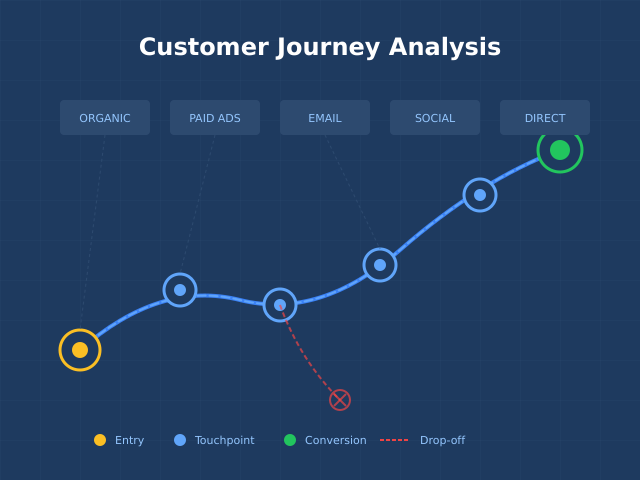
- Customer Journey Analysis: Map, Track, and Optimize Every Touchpoint
- Multi-Touch Attribution Models: How to Choose the Right One
Bottom Line
A first-party data strategy is not a response to cookie deprecation — it is the foundation of modern, effective marketing. The data you collect directly from customers is more accurate, more privacy-compliant, and more valuable than anything you can purchase from a broker.
Start with the data you already have. Audit your existing systems, implement proper consent management, deploy server-side tracking to fill collection gaps, and invest in identity resolution to unify customer profiles across channels. Then activate that data through personalization, segmentation, and predictive analytics.
The companies that win in the post-cookie era are not the ones with the most data — they are the ones with the best data. First-party data, collected with consent and activated with purpose, is that data. Every month you delay building this capability is a month your competitors use to widen their advantage.