Audience Segmentation: The Complete Guide to Targeting the Right Users
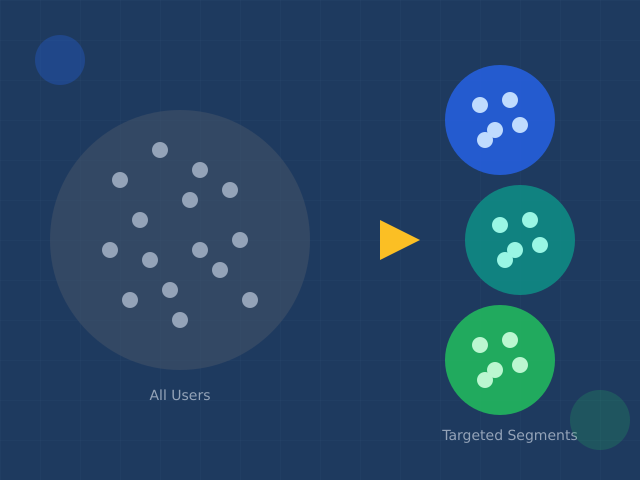
Sending the same message to everyone means resonating with no one. Audience segmentation fixes that problem by dividing your users into groups that actually share characteristics—then targeting each group with relevant messaging, offers, and experiences.
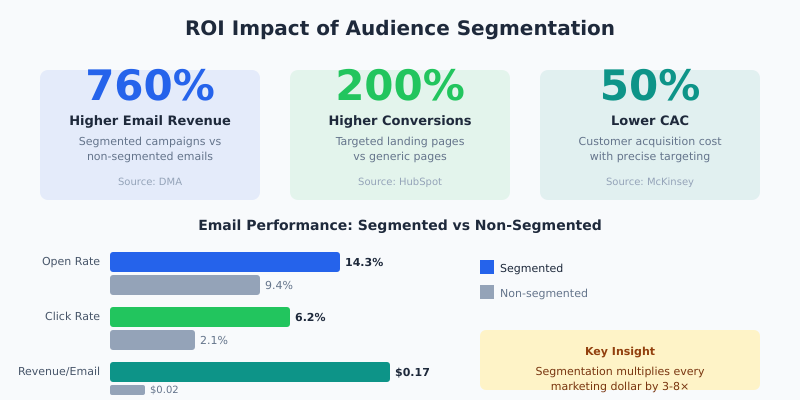
The data supports this approach: segmented campaigns generate 101% higher engagement than non-segmented ones. Even more striking, research shows 77% of marketing ROI comes from segmented, targeted, and triggered campaigns. The remaining 23% comes from broadcast messaging to undifferentiated audiences.
Yet most businesses segment poorly—if at all. They collect data without acting on it, create segments they never use, or build segments so broad they’re meaningless. This guide covers the eight core segmentation types, when to use each, and how to measure whether your segments actually work.
What Audience Segmentation Actually Means
Audience segmentation divides your customer base into distinct groups sharing common characteristics. Instead of treating all users identically, you identify patterns that predict behavior, preferences, or value—then tailor your approach to each group.
Effective segmentation requires three elements:
- Measurable criteria: You can identify and quantify who belongs in each segment
- Meaningful differences: Segments behave differently enough to warrant different treatment
- Actionable size: Each segment is large enough to justify targeted efforts
A segment of “users who visited the pricing page” meets all three criteria. A segment of “users who might be interested in our product” meets none.
Why Segmentation Drives Results
Generic messaging creates generic results. Segmentation improves performance across every marketing metric:
| Metric | Segmented vs. Non-Segmented | Source |
|---|---|---|
| Email open rates | +14% higher | Mailchimp |
| Click-through rates | +101% higher | DMA |
| Revenue per email | +760% increase | Campaign Monitor |
| Customer retention | +5% improvement = 25-95% profit increase | Bain |
Beyond metrics, segmentation enables smarter resource allocation. Instead of spreading budget across everyone equally, you concentrate spending on high-value segments where returns justify investment.
Related: Conversion Funnel Analysis shows how to identify where different segments drop off in your funnel.
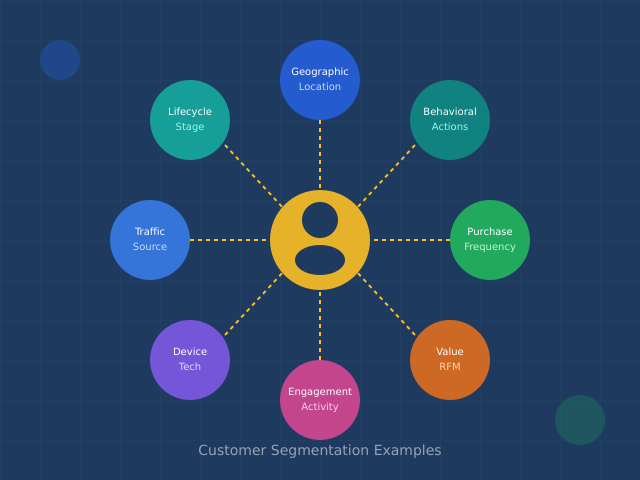
The 8 Types of Audience Segmentation
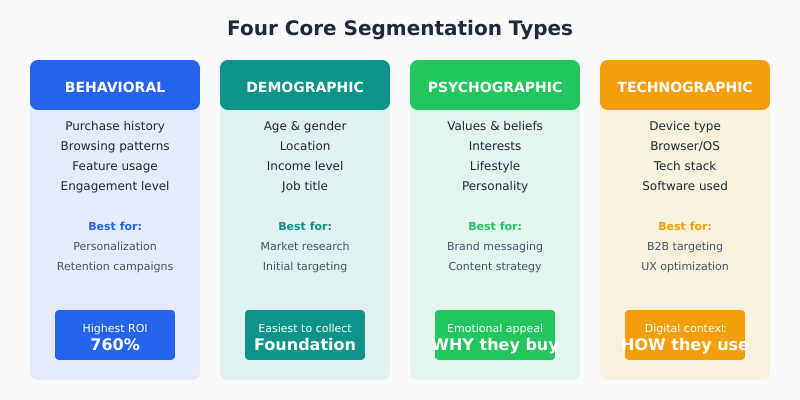
Each segmentation type serves different purposes. Most effective strategies combine multiple types rather than relying on one.
1. Demographic Segmentation
What it is: Grouping by measurable population characteristics—age, gender, income, education, occupation, family status.
Best for: B2C products with clear demographic preferences, initial segmentation when behavioral data is limited.
Example: A financial services company segments by income bracket: users earning $50-75K see content about building emergency funds; users earning $150K+ see content about tax-advantaged investment strategies.
| Metric to Track | What It Tells You |
|---|---|
| Conversion rate by segment | Which demographics respond to your offering |
| Average order value by segment | Which demographics have higher purchasing power |
| Customer lifetime value by segment | Which demographics deliver long-term value |
Limitation: Demographics describe who people are, not what they do. Two 35-year-old professionals with similar incomes may have completely different needs and behaviors.
2. Behavioral Segmentation
What it is: Grouping by actions users take—pages visited, features used, emails opened, products purchased, content consumed.
Best for: Personalizing user experience, identifying purchase intent, optimizing conversion paths.
Example: An e-commerce site segments by browsing behavior: users who viewed product pages but didn’t add to cart receive retargeting ads; users who added to cart but didn’t purchase receive abandoned cart emails with a discount.
| Behavioral Signal | Segment Implication | Action |
|---|---|---|
| Visited pricing page 3+ times | High purchase intent | Sales outreach, demo offer |
| Downloaded comparison guide | Evaluation phase | Case studies, competitive positioning |
| Used free trial daily | Engaged user | Upgrade prompt, premium features |
| No login in 14+ days | Churn risk | Re-engagement campaign |
Behavioral segmentation typically outperforms demographic segmentation because actions predict future actions better than attributes do.
3. Psychographic Segmentation
What it is: Grouping by psychological characteristics—values, attitudes, interests, lifestyle, personality traits.
Best for: Brand positioning, content strategy, emotional messaging, premium product marketing.
Example: Adidas segments runners not by age or location, but by motivation: competitive runners see performance metrics and race training content; casual runners see wellness benefits and social running groups.
Data sources: Surveys, social media activity, content engagement patterns, purchase motivations (collected via post-purchase surveys).
Limitation: Psychographic data is harder to collect at scale and can be less reliable than behavioral data. It works best combined with other segmentation types.
4. Technographic Segmentation
What it is: Grouping by technology usage—device type, operating system, browser, software stack, tech sophistication level.
Best for: Software companies, tech products, UX optimization, B2B targeting.
Example: A SaaS company segments by current tech stack: users running legacy systems see migration assistance messaging; users on modern cloud infrastructure see advanced integration capabilities.
| Technographic Signal | Segment Implication |
|---|---|
| Mobile-only users | Prioritize mobile experience, shorter content |
| Desktop power users | Complex features, detailed documentation |
| Uses competitor tool | Competitive positioning, migration support |
| Early adopter tech stack | Beta features, cutting-edge capabilities |
Related: Plausible Analytics Review covers privacy-first approaches to collecting technographic data without cookies.
5. Transactional Segmentation
What it is: Grouping by purchase behavior—purchase frequency, average order value, recency, product categories bought, payment preferences.
Best for: E-commerce, subscription businesses, customer loyalty programs, revenue optimization.
Example: Using RFM analysis (Recency, Frequency, Monetary), segment customers into value tiers:
| Segment | Characteristics | Strategy |
|---|---|---|
| Champions | Recent, frequent, high-value purchases | Loyalty rewards, early access, referral programs |
| Loyal Customers | Frequent purchases, moderate value | Upsell, cross-sell, increase AOV |
| At Risk | Previously frequent, now inactive | Win-back campaigns, special offers |
| New Customers | Recent first purchase | Onboarding, second purchase incentive |
| Dormant | No recent activity, low historical value | Low-cost reactivation or sunset |
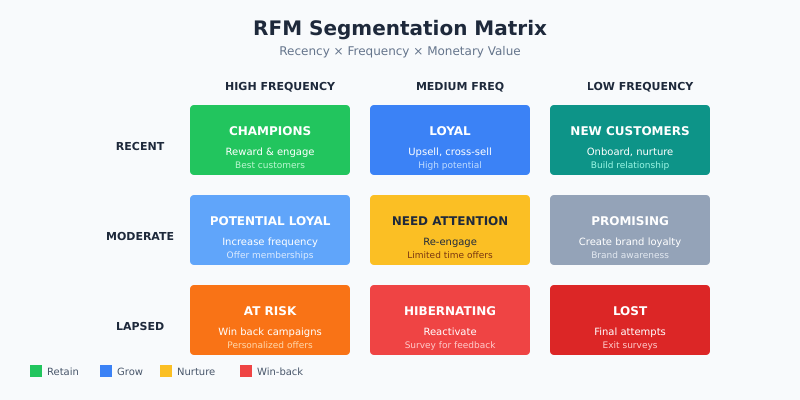
Transactional segmentation directly ties to revenue, making it essential for businesses with repeat purchase models.
6. Geographic Segmentation
What it is: Grouping by location—country, region, city, climate zone, urban/rural, time zone.
Best for: Location-specific products, local marketing, regional pricing, compliance (GDPR, CCPA).
Example: North Face shows different product recommendations based on location: users in Colorado see hiking and ski gear; users in Florida see water sports and running equipment.
Analytics application: Geographic segmentation in your analytics reveals regional performance differences. A page that converts at 5% in the US but 1% in Germany might indicate localization issues—language, currency, shipping costs, or cultural relevance.
7. Lifecycle Segmentation
What it is: Grouping by stage in the customer journey—prospect, new customer, active customer, at-risk, churned, reactivated.
Best for: Email marketing, customer success, retention optimization, journey mapping.
| Lifecycle Stage | Time-Based Trigger | Communication Focus |
|---|---|---|
| New signup | Day 0-7 | Onboarding, quick wins, feature discovery |
| Activated | Completed key action | Deeper engagement, use case expansion |
| Established | 30+ days active | Advanced features, loyalty program |
| Declining | Usage dropping | Check-in, feedback request, value reminder |
| Churned | Cancelled/inactive 30+ days | Win-back offer, exit survey insights |
Lifecycle segmentation ensures you’re sending the right message at the right time, not asking new users to refer friends or offering discounts to your most engaged customers.
8. Predictive Segmentation
What it is: Grouping by predicted future behavior using machine learning models—likely to purchase, likely to churn, predicted lifetime value, next product interest.
Best for: Proactive interventions, resource prioritization, advanced personalization.
Example: A subscription service predicts churn probability based on usage patterns, support tickets, and engagement decline. Users with >70% churn probability receive proactive outreach from customer success before they cancel.
Requirements: Predictive segmentation requires sufficient historical data (typically 6+ months), data science capability, and integration between your analytics and marketing systems.
According to market research, the audience analytics market—driven largely by predictive capabilities—is projected to grow from $5.1 billion in 2025 to $21.85 billion by 2033.
B2B Addition: Firmographic Segmentation
For B2B businesses, firmographic segmentation groups accounts by company characteristics rather than individual traits:
| Firmographic Attribute | Segmentation Use |
|---|---|
| Company size (employees) | SMB vs. mid-market vs. enterprise positioning |
| Annual revenue | Pricing tier, contract size expectations |
| Industry vertical | Use case messaging, case studies, compliance focus |
| Technology stack | Integration emphasis, migration support |
| Growth stage | Startup vs. scale-up vs. established messaging |
Enterprise buyers have different evaluation processes, stakeholders, and priorities than SMB buyers. Treating them identically wastes resources and reduces conversion rates.
Common Segmentation Mistakes
Segmentation fails more often from execution problems than strategy problems:
Mistake 1: Creating Segments You Can’t Act On
A segment only has value if you can reach it with differentiated messaging. “Users who are price-sensitive” is useless if you can’t identify them until after they’ve churned. Build segments based on observable, actionable signals.
Mistake 2: Too Many Segments
Twenty segments with 500 users each often underperform five segments with 2,000 users each. Each segment requires unique content, testing, and optimization. More segments means spreading resources thinner. Start with 3-5 high-impact segments and expand only when you’ve maximized those.
Mistake 3: Static Segments in a Dynamic World
Users change. A “new customer” becomes an “established customer” becomes “at-risk.” Segments defined once and never updated become increasingly inaccurate. Build segments that automatically update based on current data, not historical snapshots.
Mistake 4: Ignoring Segment Overlap
A user might be a “high-value customer” AND “at-risk of churn” AND “mobile-only user.” When segments overlap, you need rules for prioritization. Which segment’s messaging takes precedence? Without clear hierarchy, users receive conflicting or redundant communications.
Mistake 5: Segmenting Without Measuring
If you can’t measure whether segmented campaigns outperform non-segmented ones, you can’t justify the effort. Every segmentation strategy needs baseline metrics, control groups, and clear success criteria.
Implementing Segmentation: A Practical Framework
Follow this four-step framework to implement audience segmentation effectively:
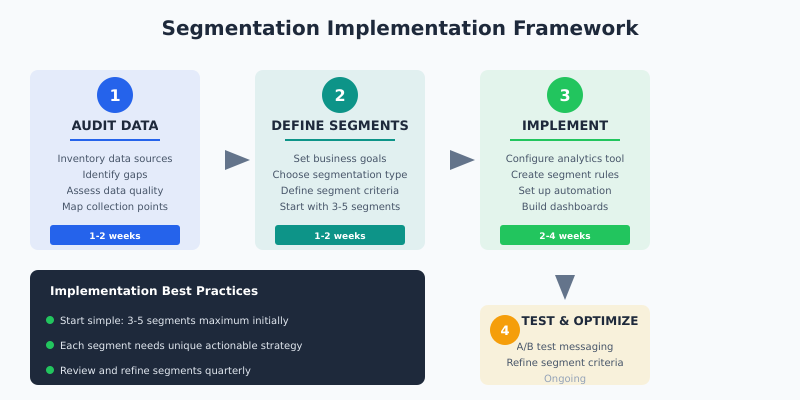
Step 1: Audit Your Data
Before building segments, inventory what data you actually have:
- What user attributes do you collect?
- What behaviors do you track?
- How accurate and complete is your data?
- Can you connect data across touchpoints (website, email, product)?
Segmentation quality depends on data quality. Gaps in tracking create blind spots in segmentation.
Step 2: Identify High-Impact Segments
Start with segments that directly impact business metrics:
- Highest value: Who are your best customers? What do they have in common?
- Highest potential: Who shows signals of becoming high-value?
- Highest risk: Who are you about to lose?
- Largest opportunity: What’s your biggest underperforming segment?
Step 3: Build and Validate Segments
For each segment, define:
- Inclusion criteria: What rules determine segment membership?
- Size: How many users currently qualify?
- Differentiation: How does this segment behave differently from others?
- Action: What will you do differently for this segment?
Step 4: Test and Measure
Run segmented campaigns against control groups. Measure:
- Engagement lift (opens, clicks, time on page)
- Conversion lift (leads, purchases, signups)
- Revenue impact (segment revenue vs. control)
- Efficiency gain (cost per conversion by segment)
Related: The Psychology Behind High-Converting Landing Pages explains behavioral principles that make segmented messaging more effective.
Tools for Audience Segmentation
Different tools serve different segmentation needs:
Analytics platforms:
- GA4: Built-in audience builder, predictive audiences, integration with Google Ads
- Mixpanel/Amplitude: Behavioral cohorts, user journey analysis, retention by segment
- Privacy-first options: Plausible, Fathom for basic segmentation without cookies
Marketing automation:
- HubSpot, Marketo, Pardot: Contact segmentation, lead scoring, automated nurture paths
- Klaviyo, Drip: E-commerce segmentation, purchase behavior triggers
Customer data platforms (CDPs):
- Segment, mParticle: Unified customer profiles across touchpoints
- Real-time segmentation: Dynamic segments that update as behavior changes
For most businesses, the analytics platform handles segment discovery; the marketing automation platform handles segment activation.
Privacy Considerations
Segmentation relies on data, and data collection faces increasing regulation:
- GDPR/CCPA compliance: Users must consent to data collection used for segmentation
- Cookie deprecation: Third-party cookie restrictions limit cross-site behavioral tracking
- First-party data priority: Owned data (email engagement, product usage) becomes more valuable as third-party data becomes less available
Build segmentation strategies on first-party data you collect directly. This data is more accurate, more compliant, and more durable than third-party alternatives.
Related: Mistakes When Switching Analytics Platforms covers privacy considerations when changing your analytics stack.
Continue Learning
Deepen your segmentation and analytics knowledge:
- Conversion Funnel Analysis — track how different segments move through your funnel
- Psychology of High-Converting Landing Pages — apply behavioral insights to segment-specific pages
- Digital Marketing Trends 2026 — where segmentation and personalization are heading
Bottom Line
Audience segmentation isn’t about creating complexity—it’s about recognizing complexity that already exists. Your users aren’t identical. They have different needs, different behaviors, different value potential. Segmentation simply acknowledges that reality and responds accordingly.
Start with one or two high-impact segments based on behavioral signals. Measure whether segmented treatment outperforms generic treatment. Expand only when you’ve proven value. The goal isn’t maximum segments—it’s maximum relevance with minimum complexity.
Businesses that master segmentation don’t just see higher engagement metrics. They build deeper customer relationships by consistently delivering relevant experiences. In a world where 81% of customers expect personalization, segmentation is the foundation that makes personalization possible.